
The UK's sustainable aviation fuel sector is at a pivotal moment. With the Revenue Certainty Mechanism (RCM) now being designed by the Department for Transport, the decisions made in the coming months will shape whether Britain builds a genuinely world-leading SAF industry - or simply imports one.
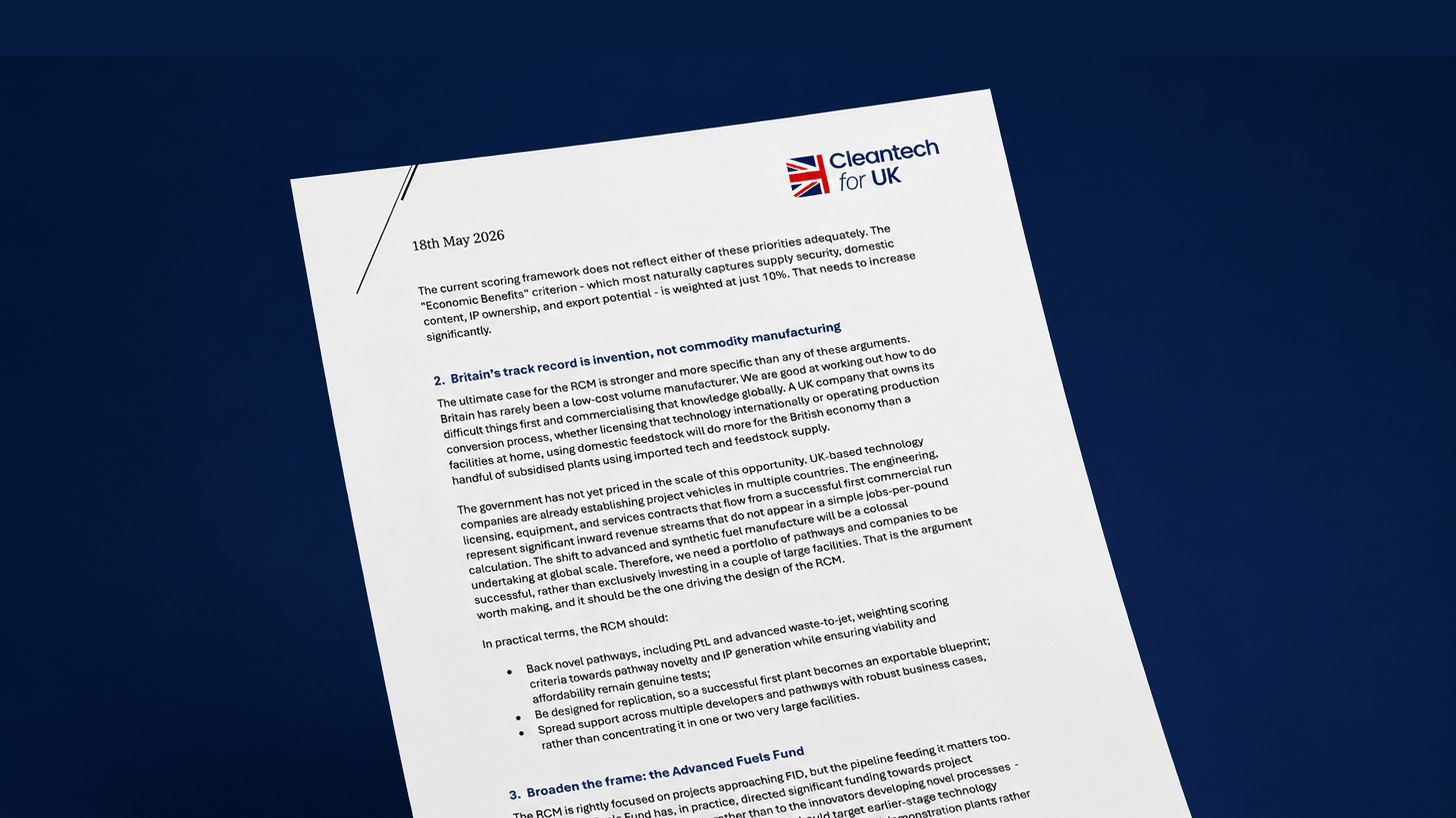
This week, Cleantech for UK joined seven leading British clean technology companies in writing directly to the Secretary of State for Transport, Heidi Alexander MP, to make the case for getting this right.
The RCM represents a significant commitment of public money. Our position is straightforward: that support should flow to companies delivering UK innovation, using domestic feedstocks, creating real export potential, and strengthening British energy security.
Specifically, we are calling on the Department for Transport to rebalance the scoring criteria to reward UK economic value, and to spread support across a portfolio of pathways and developers. That second point matters as much as the first. A diverse portfolio approach builds economic resilience and stimulates a genuine UK SAF industrial capability, rather than concentrating risk and reward in a small number of large incumbents.
Download the letter
SAF is often discussed purely as a decarbonisation tool for a hard-to-abate sector, and it is that. But the industrial opportunity is considerably larger. The global SAF market is projected to grow enormously over the coming decades as regulatory pressure, airline commitments, and passenger expectations converge. The technology pathways being proven today - from waste-based and advanced feedstocks to power-to-liquid routes - will underpin a multi-billion pound global supply chain.
The UK has a genuine competitive advantage here. We have strong feedstock availability, a deep research base, and a track record of working out how to do difficult things first and commercialising that knowledge globally. The question is whether public policy accelerates that or gets in the way of it.
A poorly designed RCM could do exactly that. If the mechanism defaults to criteria that favour scale and speed of deployment over domestic content and innovation depth, the likely outcome is that public subsidy supports overseas-developed technology deployed in the UK, rather than British companies scaling up and exporting. That would be a significant missed opportunity - both for the climate and for UK industrial strategy.
The coalition of companies behind this letter represents exactly the kind of innovative, domestically-rooted businesses the RCM should be designed to support. We hope the Department for Transport will take this in the spirit it is intended: constructive, expert, and urgent.






.svg)