
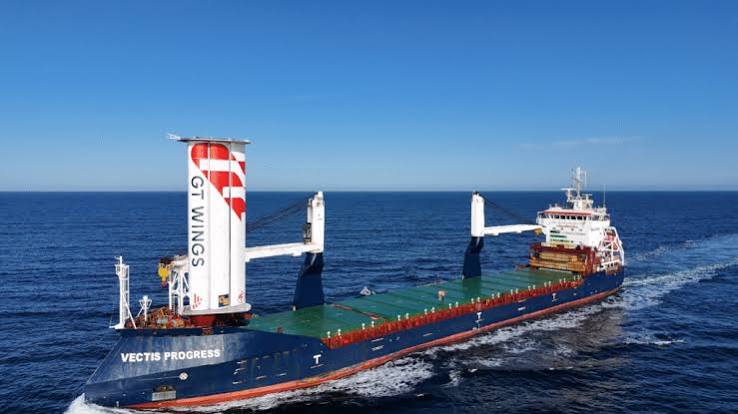
GT Wings has developed a high-lift wind propulsion system that draws on aerospace engineering to cut fuel use by up to 35%. We spoke to founder and CEO George Thompson about the technology, the challenges of commercialising it, and what the UK needs to do to support maritime cleantech.
Q Can you tell us how GT Wings came about and where the technology comes from?
I'm a naval architect by profession. I started my career working on high-performance race yachts in the Americas Cup, and over the past nine or ten years I've been working in the wind propulsion space in various forms, including consultancy helping companies do due diligence on emerging technologies in this area.
The company as it exists today grew out of a gap in the market. There was no system capable of producing a large amount of thrust from a wind unit that was significantly more compact than what else was available. The idea came from high-lift aeronautical applications - NASA papers on certain airfoil devices designed to increase lift on aircraft. We realised that principle could be translated into a wind system for ships.
In practical terms, the system works through a combination of suction and blowing. It draws flow in from one part of the surface and expels it onto another, manipulating airflow in a way that generates much greater thrust from a smaller footprint. That means less disruption to port operations, less impact on cargo loading and unloading, and the ability to install on vessels where conventional wind systems simply wouldn't fit.
“The data from our first wing is closely matching our predictions. That was the big tick in the box for the whole demonstration project.”
Q What have been the biggest challenges in getting to where you are now?
Funding is the first hurdle. These are large, heavy, expensive pieces of kit. Getting a ship owner to commit to putting one on their vessel at the early stage, when you're essentially starting from scratch, is very difficult.
From an engineering perspective, there's also the challenge of novelty. Because what we're doing hasn't been done before in this way, we had to test and simulate extensively in a computational environment before making the leap to a full-scale real-world installation. That's a significant moment of uncertainty. The good news is that the data coming back from our first wing is closely matching our predictions, which was the big validation we needed from the whole demonstration project.
Q What kind of fuel savings are you seeing in practice, and at what point does this become an obvious commercial decision for ship owners?
For our first installation - a 120-metre vessel with a single wing - we're projecting average savings of around 8 to 10%. We're building up that picture gradually through what we call stop-start testing: running the wing on, measuring fuel consumption and vessel speed, then aligning it with the wind and measuring again in the off configuration. The difference is clear, and the results are tracking our predictions well.
For larger vessels with multiple wings, the numbers are significantly higher - potentially up to 35% on certain routes. The actual saving depends on the number of wings installed, vessel size, positioning, and the specific route. We do a detailed simulation for every ship owner so they know what to expect, and that methodology has now been independently verified by Lloyd's Register.
Crucially, we've now reached the point where the performance and cost of our product creates a viable business case based purely on fuel savings alone - without needing to factor in ETS credits or future IMO carbon pricing. That's a significant milestone. A lot of ship owners have historically evaluated these decisions on fuel cost alone, so being able to meet them on those terms changes the conversation entirely.
“We’ve reached the point where the cost and performance of our product creates a business case on fuel savings alone.”
Q Thinking specifically about the UK: what does the country need to do to support technologies like this?
Grant funding has been critical for us,and Innovate UK in particular has been very important in helping bridge the valley of death associated with demonstrating and commercialising the product. That kind of support is essential for deep tech hardware companies where the capital requirements are high and the timelines are long.
IP protection also matters enormously. Our core design, control systems, software, and hardware are all developed and held within the UK,and keeping that in the UK is a priority. Steel fabrication of the wings themselves needs to happen locally to wherever the installation takes place - if a ship is in Japan, we fabricate those components in Japan - but the intellectual heart of the company stays here.
UK Export Finance is another area we're just starting to engage with. Because at least 20% of the product value is UK-based, there are some genuinely attractive financing structures available, including leasing arrangements and service-based models - what you might call a power-by-the-hour approach, similar to what Rolls-Royce does in aerospace. That kind of financing could open the technology to a much wider range of ship owners, including smaller operators who couldn't otherwise afford the upfront capital.
Q Who is your ideal customer, and where are you focusing commercially over the next few years?
The best customers are owner-operators - companies that both own and operate their ships. Because they receive the fuel and carbon savings directly while also bearing the capital cost, the incentives are fully aligned. Where you have separate vessel owners and charterers, you often have a split-incentive problem that requires more creative commercial structuring.
At the moment, our strategy is to focus on the larger, blue-chip fleet operators who are in a position to move early. But as regulation tightens - and IMO and EU ETS frameworks are both pushing in that direction - we expect uptake to broaden significantly across the market. The financing solutions we're developing are part of making that possible for smaller operators too.
On the supply chain and partnership side, we're building regional fabrication and maintenance networks in key geographies. The recently announced MOU with a manufacturing partner in China is part of that, complementing our existing European supply chain. Global reach on after-sales and maintenance is something we're also actively working on - it's essential if we want to be a true market leader rather than just a technology developer.
Q What does success look like over the next five years?
The target is 600 wing installations. That requires a significant scale-up in manufacturing and sales, and it would represent a meaningful reduction in global shipping emissions. We'll share the carbon abatement figure once we've confirmed the number - it's a compelling one.
The ambition is to be the market leader in wind-assisted propulsion. To get there, you need the right product, the right partners, and the right financing structures in place. We're making good progress on all three fronts. Our focus now is executing that strategy at global scale.
GT Wing's new video is now live and you can watch it here: https://youtu.be/SKN3wV0ANqU






.svg)